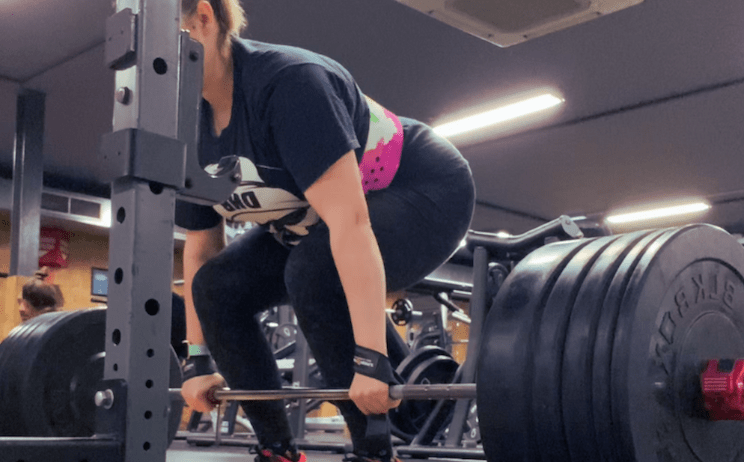
This isn’t a typical personal birth story. It’s a record of what it felt like in my body and mind as things unfolded, including the parts that surprised me, confused me, or didn’t match the story I thought I knew. The moments that don’t make it into films or fairy tales. It’s told from the perspective I had at the time, raw and unfiltered, as I experienced it.
Before the Sweep
On Monday, at 40 weeks and one day, I had a cervical sweep. I’d been told by other mums it wouldn’t hurt, that it would be “just a bit uncomfortable”. It was not just a bit uncomfortable. It was painful. A sharp but familiar, period-cramp-like pain hit harder than I expected, perhaps because I hadn’t felt anything like it for nine months. I lay there trying to look brave while silently renegotiating my understanding of “uncomfortable”. Afterwards, I was told I was two centimetres dilated and sent home, slightly shocked, slightly hopeful and very aware that things suddenly felt real.
It was my first reminder that birth doesn’t follow anyone else’s script. What’s “just uncomfortable” for one person can feel very different for another.
The next day, I lost my mucus plug, or at least something that looked convincingly like it. I took it as a sign that things were finally moving. They weren’t. Nothing else happened. I had an induction booked for the following Monday, but I was quietly hoping the baby would decide to make an independent entrance before then.
Signs of labour
On Friday morning, I woke up with mild cramps. I half-joked to myself that this might be labour, but I went about my day anyway. Even so, something felt off. The baby hadn’t been moving as much.
Before calling triage, I lay down and tried to feel her properly. I played her lullabies, rested my hand on my belly and spoke to her quietly. I remember thinking this might be the last time I talk to her like this, through my body.
And it was.
Eventually, I decided to call triage, just to be safe. The midwife suggested I come in to be assessed. Because I already had an induction booked, she said they might induce me that day, but even if they did, it would likely take hours. I asked if I should bring the hospital bags. She said no.
So I had a shower, got dressed and decided to take the bus. I was still expecting a standard check-up for reduced movements. I’d been there before. Everything felt routine. There was no urgency. Not yet.
On the bus
A friend had recommended a contraction-tracking app, so on the bus I started logging my very mild cramps.
“14:25. Twenty-three seconds.”
Seven minutes later, another one. Slightly longer.
I met Chris at the station, and we took another bus to the hospital. It was only a ten-minute ride, but by then the cramps were stronger. What had been seven minutes apart quickly became three. The app sent a notification telling me to get ready for the hospital. I glanced at it and laughed.
Triage
That Friday, triage was the busiest I’d ever seen it. The waiting room was full of people in late pregnancy and those waiting with them. We sat down, but I quickly had to stand again. Sitting made the contractions worse.
They kept coming. Stronger now. Longer. Every two or three minutes.
Another notification popped up telling me to go to the hospital. Ironically, I was already there.
I stood in the corridor, leaning against the wall, breathing through contractions that were now lasting at least a minute. Midwives walked past. No one stopped to ask if I was okay. I wasn’t. It was hot. I wanted to lie down, or drop to my hands and knees, or just not stand there so exposed.
I thought about hypnobirthing, about contractions being like waves that rise, peak and fall. I told myself it was only a minute. Like a minute of burpees. I can survive a minute of those.
Can I?
About an hour and a half later, a nurse checked me for reduced movements. I told her I was having intense contractions. She said I needed to be seen by the delivery team. And then I waited again, my patience already stretched from the hour and a half before, unsure how long this one would be.
Around 17:00, a midwife examined me. Five centimetres dilated. She could feel the baby’s head. After that, the contractions intensified even more.
“We need to move you,” she said. “The baby could be here very soon.”
Somehow, I walked to the delivery room.
From there, things began to blur.
The delivery room
There was gas and air. Learning how to breathe through it. Getting high on it. Lying on my side and suddenly feeling an urge to push so strong it was completely uncontrollable.
You don’t decide what to do in that moment. You surrender. You let your body take over.
I breathed in. I breathed out. Another wave.
My waters broke. There was meconium. I could hear the midwives talking, but everything sounded muffled. I was terrified of the next urge to push, certain it would kill me.
It didn’t.
At some point, high on gas and air, my mind drifted. I was nineteen again, at university, drunk on brandy and having the best time with my friends. Surreal. I couldn’t believe I was in labour and having this out-of-body experience at the same time.
The next urge arrived, sharp and insistent. Until now, my body had known exactly what to do. I hadn’t needed to add anything. But I was tired, impatient, and eager to meet my baby, and I thought maybe I could help things along. I pushed in addition to the urge. The midwife told me to stop as soon as I started, but I didn’t know any better.
The last push
The following contraction was stronger than the last. I was barely there, eyes closed, drifting in and out of myself. The urge to push was unbearable, my head ready to split open.
Good thing I had the gas and air mask on. I’m pretty sure I was roaring like some wild animal.
Suddenly, the uncontrollable urge stopped. I thought it was over. I thought the baby was out.
But no. The midwives said I had to push. My half-asleep, high-on-gas brain heard them say the baby’s foot was stuck. Push? I thought. But the baby’s already here… except the foot? How can that even be? I’ll have to push it myself? I don’t have it in me anymore.
But I did.
I pushed. And pushed. And pushed.
Happy ever after
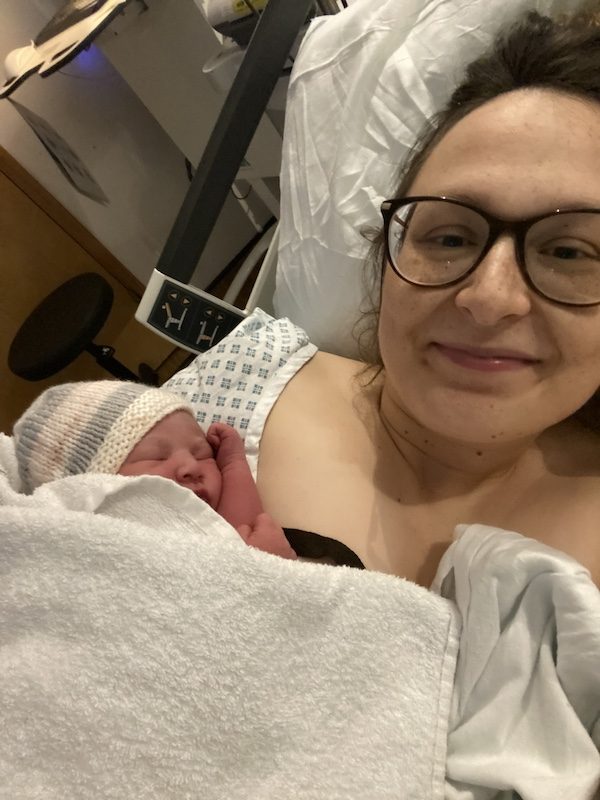
At 19:15 she arrived. Loud. Alive. Here.
When they lifted her and passed her to me, I remembered where I was. I opened my eyes and met her for the first time. She was perfect. Our Amber. Three point three kilograms. I couldn’t believe she was really here.
Everyone talks about the overwhelming love you feel for your baby. For me, it wasn’t overwhelming. It felt steady. Right.
What surprised me most was how strongly I felt for Chris. His presence, his calm, and the way he stayed close made me feel safe. I hadn’t realised how much I needed that. The baby was here. She was alive. She was okay. And in that relief, I saw him again clearly. I fell in love with him all over again.
I tried to be fully there, deliberately present, storing moments as if I were taking photographs: Chris cutting the umbilical cord, holding her tiny hands, touching her arms and her nose.
This is how fairy tales end. Happy ever after.
After
For a moment, everything went quiet. But it wasn’t what everyone had warned me about. I wasn’t exhausted. I hadn’t sweated. I felt… fine. The experience had been intense, but it became clear that fear had taken up far more space than pain.
Soon after, the midwife reminded me I still had to deliver the placenta and then get stitches. I knew it was coming, but knowing didn’t make it any less uncomfortable. Just minutes ago, I’d held my baby, and now my body had more to give. The thought alone made me feel queasy. And yet, I still had to push.
Stitches were awkward too. The baby was here in Chris’s arms, and I was left alone with this quiet, slightly scary part of birth. It wasn’t intense anymore. Just me, waiting, trying not to freak out again.
There’s a whole part of birth that begins just when people assume it has finished. We never see it in films; we hardly talk about it. And yet, it should count too. All of it. The shouting, the roaring, the messy, unbelievable, beautiful bits we barely notice.
This personal birth story is shared as lived experience. For clear, evidence-based information alongside personal accounts, the NHS provides guidance on labour and birth here and on reduced baby movements here.
If you’re interested in how culture shapes the way we relate to our bodies, you might also want to read my reflections on living in a larger body and the impact of fat-baiting here.